Tri-State’s tariff sets wholesale tests, cost obligations and financial-security requirements for covered large loads. These protections address the risk of shifting costs onto utility members; they are not a guarantee that a household’s electric bill cannot rise.
For Site Layer 4: the reviewed records do not establish the project’s tariff applicability, signed utility agreements, evaluation results or posted security. A general rule—and a letter describing it—is not proof that a particular project has met it.
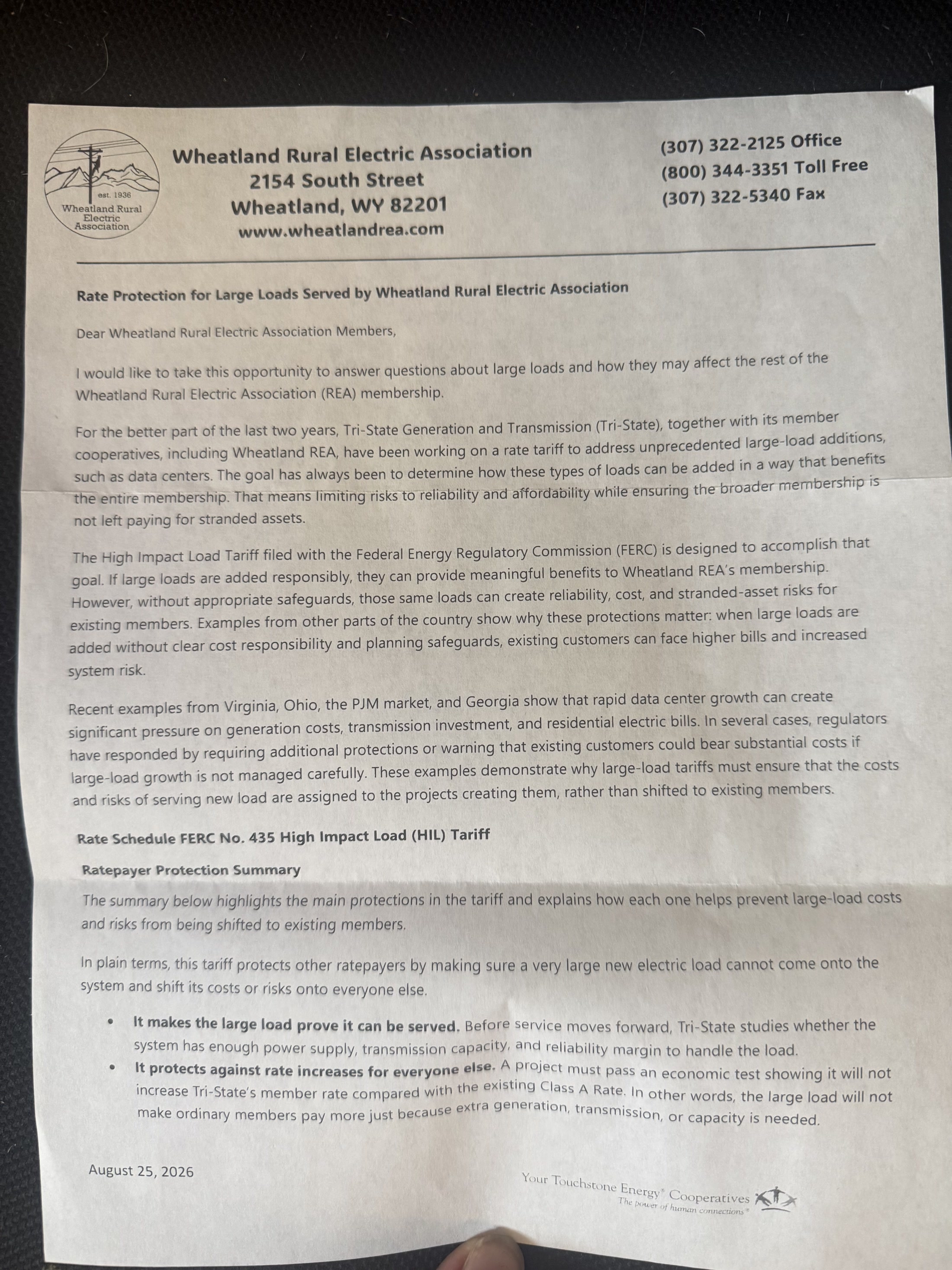
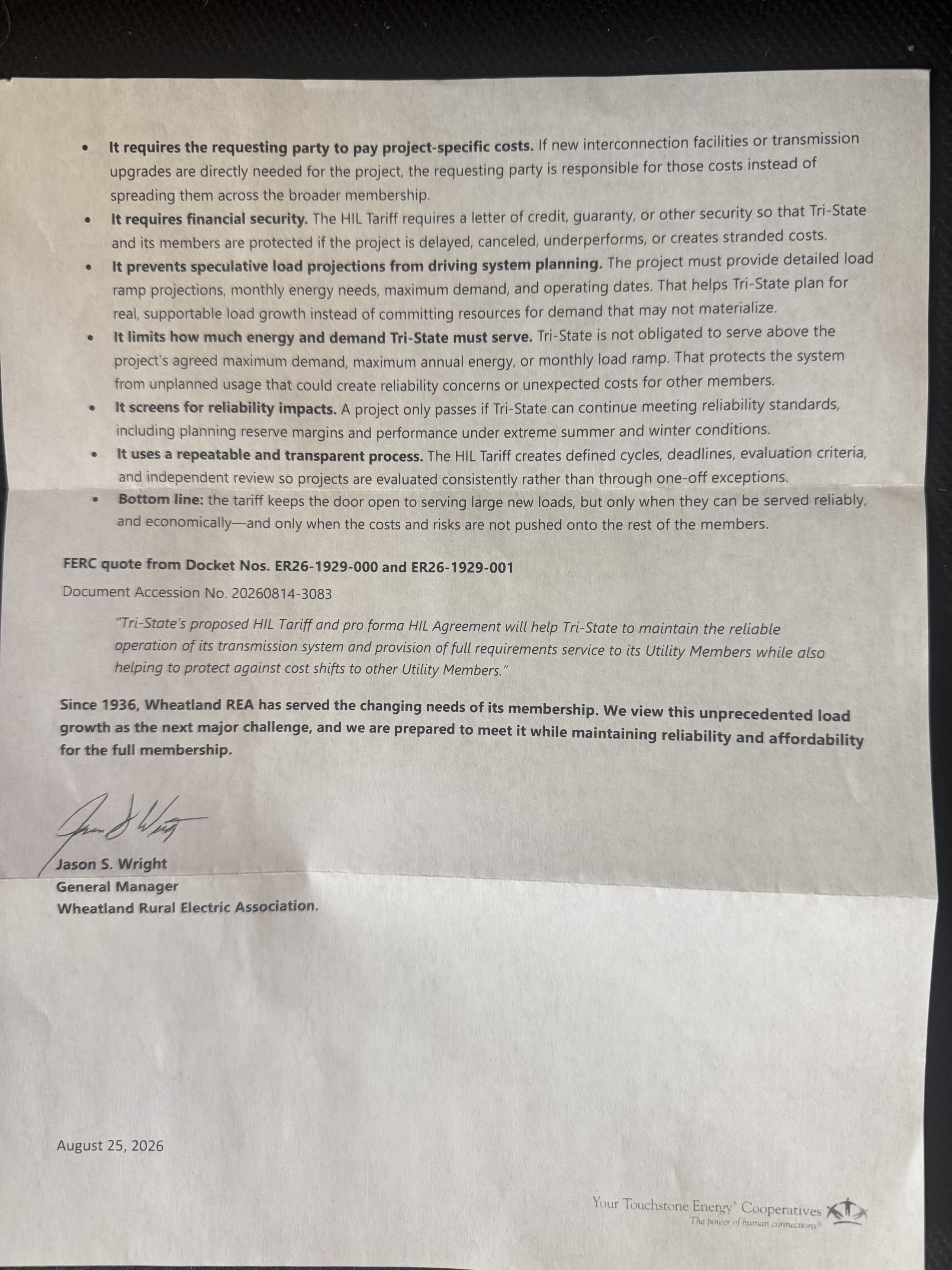
The letter says exceptionally large electric loads should be studied before service, bear specified project costs, and provide financial security so their risks are not shifted onto existing members.
It describes reliability and wholesale-rate tests, load forecasts, service limits and independent process review as protections for the cooperative’s membership.
Wheatland Rural Electric Association’s August 25, 2026 member letter describes its view of the large-load protections. The original page images and combined PDF are available below. The letter is a utility statement, not a signed Site Layer 4 contract or collateral confirmation. Wheatland REA is distinct from Wheat Belt Public Power District. Its participation does not establish that it serves every project component or sent the letter specifically because of this project. (EREA; ENERGY-023–025)
Document transcription, checked against both preserved photographs September 21, 2026. Line wrapping, bullet layout and typographic punctuation are normalized. Letterhead contact details, decorative logos and the handwritten signature image are omitted; the typed signer and dates are retained. The text below is the utility’s statement, including its examples and quoted language—not this site’s independent findings. Consult the photographs or PDF for the original.
Page 1
Rate Protection for Large Loads Served by Wheatland Rural Electric Association
Dear Wheatland Rural Electric Association Members,
I would like to take this opportunity to answer questions about large loads and how they may affect the rest of the Wheatland Rural Electric Association (REA) membership.
For the better part of the last two years, Tri-State Generation and Transmission (Tri-State), together with its member cooperatives, including Wheatland REA, have been working on a rate tariff to address unprecedented large-load additions, such as data centers. The goal has always been to determine how these types of loads can be added in a way that benefits the entire membership. That means limiting risks to reliability and affordability while ensuring the broader membership is not left paying for stranded assets.
The High Impact Load Tariff filed with the Federal Energy Regulatory Commission (FERC) is designed to accomplish that goal. If large loads are added responsibly, they can provide meaningful benefits to Wheatland REA’s membership. However, without appropriate safeguards, those same loads can create reliability, cost, and stranded-asset risks for existing members. Examples from other parts of the country show why these protections matter: when large loads are added without clear cost responsibility and planning safeguards, existing customers can face higher bills and increased system risk.
Recent examples from Virginia, Ohio, the PJM market, and Georgia show that rapid data center growth can create significant pressure on generation costs, transmission investment, and residential electric bills. In several cases, regulators have responded by requiring additional protections or warning that existing customers could bear substantial costs if large-load growth is not managed carefully. These examples demonstrate why large-load tariffs must ensure that the costs and risks of serving new load are assigned to the projects creating them, rather than shifted to existing members.
Rate Schedule FERC No. 435 High Impact Load (HIL) Tariff
Ratepayer Protection Summary
The summary below highlights the main protections in the tariff and explains how each one helps prevent large-load costs and risks from being shifted to existing members.
In plain terms, this tariff protects other ratepayers by making sure a very large new electric load cannot come onto the system and shift its costs or risks onto everyone else.
It makes the large load prove it can be served. Before service moves forward, Tri-State studies whether the system has enough power supply, transmission capacity, and reliability margin to handle the load.
It protects against rate increases for everyone else. A project must pass an economic test showing it will not increase Tri-State’s member rate compared with the existing Class A Rate. In other words, the large load will not make ordinary members pay more just because extra generation, transmission, or capacity is needed.
August 25, 2026
Page 2
It requires the requesting party to pay project-specific costs. If new interconnection facilities or transmission upgrades are directly needed for the project, the requesting party is responsible for those costs instead of spreading them across the broader membership.
It requires financial security. The HIL Tariff requires a letter of credit, guaranty, or other security so that Tri-State and its members are protected if the project is delayed, canceled, underperforms, or creates stranded costs.
It prevents speculative load projections from driving system planning. The project must provide detailed load ramp projections, monthly energy needs, maximum demand, and operating dates. That helps Tri-State plan for real, supportable load growth instead of committing resources for demand that may never materialize.
It limits how much energy and demand Tri-State must serve. Tri-State is not obligated to serve above the project’s agreed maximum demand, maximum annual energy, or monthly load ramp. That protects the system from unplanned usage that could create reliability concerns or unexpected costs for other members.
It screens for reliability impacts. A project only passes if Tri-State can continue meeting reliability standards, including planning reserve margins and performance under extreme summer and winter conditions.
It uses a repeatable and transparent process. The HIL Tariff creates defined cycles, deadlines, evaluation criteria, and independent review so projects are evaluated consistently rather than through one-off exceptions.
Bottom line: the tariff keeps the door open to serving large new loads, but only when they can be served reliably and economically—and only when the costs and risks are not pushed onto the rest of the members.
FERC quote from Docket Nos. ER26-1929-000 and ER26-1929-001
Document Accession No. 20260814-3083
“Tri-State’s proposed HIL Tariff and pro forma HIL Agreement will help Tri-State to maintain the reliable operation of its transmission system and provision of full requirements service to its Utility Members while also helping to protect against cost shifts to other Utility Members.”
Since 1936, Wheatland REA has served the changing needs of its membership. We view this unprecedented load growth as the next major challenge, and we are prepared to meet it while maintaining reliability and affordability for the full membership.
Jason S. Wright General Manager Wheatland Rural Electric Association.
August 25, 2026
View the two original photographs
Page 1 · Select to open full sizePage 2 · Select to open full size
Who has agreed to pay, and what secures the obligation?
First establish the serving utility, delivery point, electrical connections and requested load by phase. Applicant descriptions of on-site generation do not prove permanent isolation or determine tariff coverage. [ENERGY-024–025]
HILA: Agreement between the utility member and Tri-State. The member signs with its participation package; Tri-State countersigns after successful evaluation. Obtain the completed agreement and exhibits. Conforming agreements are not individually filed at FERC; missing public HILA results do not prove absence. (E3, §§5.3–5.5, Appendix A §3)
MCHIL: Contract between the member and its retail customer. Obtain the actual cost recovery, minimum payment, security, default, transfer and termination terms. The tariff does not itself prove that every wholesale cost has been passed to the developer. (E1, ¶¶66–68,75; E3, §5.6)
Facilities Construction Agreement: Verify specified directly assigned work, costs and security, any SPP Attachment AX treatment, and any agreed timing variation. The usual prerequisite is before the applicable OATT study agreement unless otherwise mutually agreed; the executed FCA filing clock is 15 Business Days after Tri-State receives it. (E3, §6.2)
Posted security: Obtain due notices, amount calculations, instruments, receipt and continuing validity. HILA security can use qualifying credit support or cash; it is not automatically an all-cash deposit. HILA termination protection does not automatically cover FCA damages or county claims. (E3, Appendix A §§7,10)
Evaluation and service readiness: Obtain the wholesale economic/reliability evaluation, independent process review or releasable summary, facility completion evidence and Serve Ready Notice. General requirements are not project compliance findings. (E3, §§5.9–5.13, Appendix A §§3–4)
General framework and project evidence
Protection, evidence status and supporting detail
Protection
Evidence status
Responsibility & evidence
E01 — Wholesale economic/planning framework
General tariff accepted subject to condition. Protects defined wholesale interests; does not guarantee unchanged retail bills.
Details & sources for E01
Vehicle / responsible body
HILT / Tri-State, utility member, FERC
Deadline or prerequisite milestone
Covered-load evaluation before tariff service readiness
Documented versus proposed payer
D: wholesale obligations on member; customer recovery not established. P: attributable customer costs recovered from customer.
Next step
Establish applicability, requested grid load, forecasts, and evaluation results.
The independent evaluator checks consistency with the tariff; it is not a county-commissioned public impact study. Results go to utility members subject to confidentiality. Additional public reporting and community protection need their own lawful basis and instruments. (E3, §§5.10–5.13; ENERGY-012,022,026)
Federal status, filing and dated search history
FERC accepted Tri-State’s High-Impact Load Tariff and standard agreement on August 14, 2026, subject to a compliance condition, effective July 16. The September 9 compliance filing adds a commitment to file agreements containing differing Basin terms and a cross-reference to the filing procedure. The reviewed redline verifies what was filed; subsequent acceptance remains unresolved. (E1, ¶1,¶¶80–82 and ordering paragraphs; E2, pp. 1–3; E4, pp. 8–9)
A prior September 18 research note reports a docket search covering September 9–18. The initial September 20 energy review could not complete its new search or read the two errata; those are preserved historical access limitations, not the current check. In the September 20 follow-up review, the September 20 ER26-1929 search (all subdockets, filed September 9–20, issuance and submittal, no keyword, class, industry, security or party restriction) returned only filing 20260909-5123 and notice 20260909-3058. No subsequent acceptance order appeared in that bounded result. Both erratum bodies were downloaded and read: 20260910-3111 concerns Agilitas, EL26-105-000, and 20260910-3113 concerns RWE, EL26-106-000. Neither changes Tri-State’s published deadline. See Take action for the date, next-check caveat and eFiling route. (EERR1, EERR2; FERC eLibrary; historical ENERGY-004)
Analysis: The two additions address the filing commitment required by the August order on their face. That is a comparison of texts, not FERC’s determination that compliance is accepted. (E1, E2, E3, E4)
County hearing date needs confirmation. The notice has displayed both October 7 and October 20 at 1 p.m. MDT. Confirm with the Planning Office before attending. No confirmed resolution was found as of September 28. Federal participation was last checked September 21; the September 9–21 docket search returned the existing filing and notice only. Sources, search boundary and remaining limits →
County context
For county status and component approvals, see Current status and E10. The reviewed records do not establish that Wheatland REA sent the letter specifically because of Site Layer 4.
Regulatory history
Preserved dated research history. The earlier October 27 rejection date remains dependent on its original linked order; it was not newly verified in the September 20 review.
First tariff filed
Tri-State submitted its first High-Impact Load Tariff in docket ER25-3316.
FERC rejected the first version
The Commission rejected the proposal over federal-versus-retail jurisdiction problems.
Revised tariff filed
Tri-State submitted a new HILT in docket ER26-1929, requesting a May 26 effective date.
Conditional approval
FERC accepted the tariff effective July 16, subject to adding a commitment to file certain agreements with different Basin Electric terms.
Compliance filing submitted
Tri-State filed ER26-1929-002, adding language in §3.6 and a cross-reference in §5.3.1. See Take action for current filing logistics and verification limits.
Research check: revised language reviewed
The order and compliance package were compared. A docket search covering September 9–18 found no subsequent acceptance order.
Electricity costs: verify the framework and the project commitments
Tri-State’s tariff provides defined wholesale planning and financial protections. The general trigger is an addition exceeding 45 MW at the Member Project Request or forecast to exceed that level within four years. Aggregation rules, a specific permanent-isolation test, and Basin/Eastern Interconnection terms qualify that description. On-site generation alone does not establish exclusion. Site Layer 4’s actual service arrangement and applicability remain unresolved. (E3, §§2.13,3.6,4.2; ENERGY-008–010,024)
The economic test concerns Tri-State’s wholesale member rate. The utility member’s obligations, the customer’s obligations, facilities costs, and actual security must be checked separately. These instruments do not establish water, noise, road, emergency-service or whole-campus cleanup protection. (E1, ¶¶64–68,75; E3; ENERGY-011–026)